

Most managers have differing views on interviewing style. Some people love to prepare, while others feel their gut instinct produces the best results. In recruiting, these two different styles are called structured and unstructured interviews.
Structured Interviews: Interviews where you come prepared with a list of questions.
Unstructured Interviews: Free-flowing interviews with little to no planned questions.
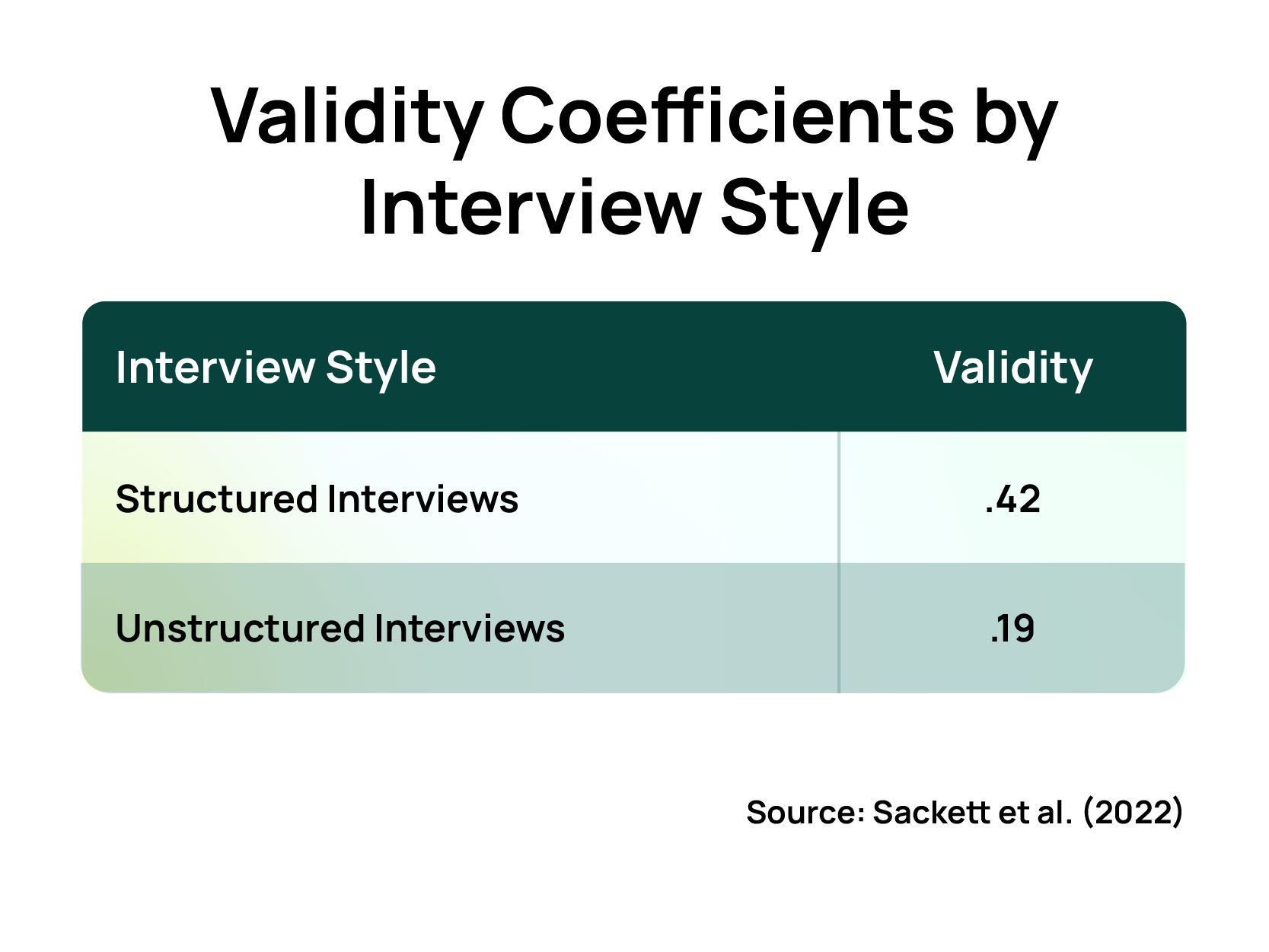
Research has shown that structured interviews vastly outperform unstructured interviews, because structured interviews are:
- Easy to replicate, which means they’re more reliable.
- Better at comparing different candidate answers.
- Better at reducing interview bias.
- More efficient with time management.
- More closely linked with the true core competencies of the job.
Steps to Create a Structured Interview
- Review the outcomes you’re looking to achieve.
- Create a list of skills, experiences, and attributes needed to produce those outcomes.
- Generate questions that evaluate those skills, experiences, and attributes.
Step one: Review the outcomes you’re looking to achieve.
Most job descriptions list tasks, but it’s much clearer to use the outcomes you’re hoping to produce. In reality, you hire people to achieve outcomes not to perform tasks. We call these Real World Outcomes, and they describe the target outcome you’re hoping the employee achieves in their role.
| Real World Outcome / Job Task |
|---|
| Customers are happy and look forward to our calls. Questions and inquiries are promptly answered, customers always feel attended to, and job openings are never ignored. |
| Colleagues are happy and the work environment is enjoyable. Help is provided generously when needed, communication with colleagues is dignifying and respectful, and reliability is of a consistently high standard. |
Step two: Create a list of skills, experiences, and attributes needed to produce those outcomes.
Every Real World Outcome requires certain learned abilities, qualifications, or inherent attributes. Start listing out what you need to achieve every outcome you’ve listed.
| Real World Outcomes | Skills | Experience | Attributes |
|---|---|---|---|
| Customers are happy and look forward to our calls. | Excellent written and verbal skills | Customer service background | High energy |
| Colleagues are happy and the work environment is enjoyable. | Strong emotional IQ | Worked closely on a team | Humility |
Step three: Generate questions that evaluate those skills, experiences, and attributes.
Research has shown that questions about the past behavior are better predictors of performance than questions about the future or hypothetical situations. These types of questions are called behavioral-based questions, and they typically start with:
“Please give me an example when you…”
“Tell me about a time when you…”
| Example Question | Looking For: |
|---|---|
| What experience do you have in customer service? | Customer service background |
| Tell me about a time you displayed emotional IQ. | Strong emotional IQ |
Conclusion
Now that you’ve created the right questions, score each candidate on their responses to those questions. You’re looking for evidence that the candidate used this skills, experience, or attributes in the past. You can use a simple rating method of 1 to 7, that way you can average the scores and compare candidates.
If you’re looking for other screening methods to complement your interview, check out our article the best screening methods.
About the Author: Jordan Berrier
